
Where Every Round Goes
By Paul Bird and Jeff Williamson
When practicing, shooters often like to “keep score.” Whether at the range or during formal training classes, we tend to focus on the number of holes in the target, how close they are to the center, and some of us “shoot against the clock” to measure progress and skill. Using metrics to improve both accuracy and speed is essential, but we sometimes ignore one of the most critical metrics.
When a firearm is used defensively, every bullet fired is your responsibility. There is no such thing as a harmless miss. A round that doesn’t hit the intended target doesn’t just disappear — it continues traveling until it strikes something, or worse, someone. In a crowded environment like a restaurant, shopping mall, or church, that “miss” could hit an innocent bystander, possibly even a child. That’s why it’s critical to remember a vital truth per Tom Givens of Rangemaster: “there are no misses in a gunfight, only unintended hits.”
If you carry a firearm for self-defense, you must train and think differently. It’s not enough to be proficient at punching paper from a perfect stance at the range. Real-life defensive shootings are dynamic, chaotic, and stressful. Your field of fire may include moving people, moving objects, unpredictable angles, and limited visibility. In these situations, a single careless shot can have devastating consequences — legally, morally, and spiritually. That single careless shot could change a life forever or even worse, could end a life.
For this reason, training must emphasize accountability for every round fired. Shooters should practice shooting from awkward positions, engaging moving targets, and making split-second decisions about whether they even should take a shot. Sometimes the most responsible decision is to hold fire to prevent unnecessary harm.
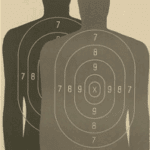
Most of us have seen the B27M (see Figure 1) silhouette target that has one figure superimposed over the other. The goal is to engage the “rear” image while not hitting the hostage in front. That scenario could happen tomorrow. Are you ready for it?
Practical Exercise.
Using a B27M Hostage Target
The “Good Guy” must stand in a box about 30 inches square. Facing him is a series of silhouettes, some close, some far. Some of them are placed in such a way that one bullet could pass through two targets, simulating over-penetration. And finally, some are designated bad guys and others are designated innocents. Without leaving the box, the shooter must engage all bad guy targets and avoid striking any innocents. You can add increased pressure on yourself by mandating that the targets be engaged according to which one is the primary threat (maybe closest) – or by introducing a timer.
However, you must remember that these drills are conducted in a “least stress environment”. They are on a controlled range and the targets are stationary. There is no danger here of injuring someone if you miss your target. Your only downside is that you might hit the wrong area on a piece of paper. In a real-world crisis taking this type of shot is horribly risky and you must live with the consequences of your choice for the remainder of your life.
For those working in church security, security work isn’t just about stopping a threat; it’s about protecting the entire congregation. That means thinking beyond “Can I hit the target?” and asking instead, “Where will this bullet go if I miss?” or “Where will this bullet go if it over-penetrates my attacker?” Proper mindset, realistic training, and disciplined trigger control are essential to ensure that when lives are on the line, every round fired serves its true purpose — safeguarding the innocent.
And now, a shameless plug for courses at Boondocks. Taking Defensive Pistol I or Defensive Pistol II at Boondocks will begin to give you some of the training you need to not just carry a gun but to fight with the gun.
