Training to Win: Understanding the Levels of Firearms Training
One of the most common mistakes armed citizens make is assuming that practice equals preparedness. Shooting occasionally at the range—or even completing a basic permit class—can create a false sense of confidence. In reality, winning a defensive encounter requires structured, progressive training that prepares the defender for stress, chaos, and decision‑making under pressure.
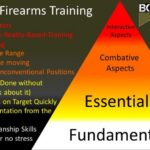
Training to Win was a seminar that I presented at USCCA’s Concealed Carry Expo back in 2021, and it was the basis of our training at this year’s Pow Wow. The goal was to lay out a clear framework for understanding how defensive training should progress. The framework relies heavily on Dave Spaulding’s “Building A Combative Pistol Program” visualized as a pyramid, with each level building on the one below it. Skipping levels or stopping too early leaves critical gaps that may surface at the worst possible moment. Let’s break down each level of training and why it matters.
Level 1: Fundamentals — The Foundation of Everything
The base of the training pyramid is fundamentals. These include; Safe gun handling, grip and stance, trigger control, sight alignment and sight picture, drawing, reloading, and clearing malfunctions. This is where most formal instruction begins—and where many shooters stop. Dave Spaulding does not include this level in his assessment because he believes everyone should strive to go above the basics or fundamentals. Every advanced skill relies on these actions being performed correctly and consistently, if you don’t get the fundamentals right, it will show up drastically in the other levels.
Fundamental Training Classes at Boondocks include; Beginner Handgun for Women Only, Basic Pistol/MS Enhanced Permit, and Precision Pistol.
Level 2: Essentials — Speed Meets Accuracy
Once the fundamentals are solid, training must progress to the essentials, where shooters learn to perform those skills quickly and efficiently. This is where Dave suggests the combative application of the handgun really starts. This level focuses on; rapid presentation from concealment, recoil management, trigger reset during recoil, timed drills, multiple targets and transitions
At this stage, the gun is being brought into the fight with urgency. Accuracy still matters, but now it must be delivered under time pressure. Shooters begin developing automaticity—the ability to perform critical tasks without conscious thought. Many defensive encounters are decided in seconds. If a shooter must think through each step of the draw or trigger press, reaction time increases and performance deteriorates under stress. The essentials bridge the gap between static range practice and real‑world demands.
The Essential Training Classes at Boondocks is our flag ship Defensive Pistol Class and Low Light Pistol.
Level 3: Combative Training — Preparing for Chaos
The third level introduces combative elements, where training begins to reflect the unpredictability of real defensive encounters.
This includes; movement (“getting off the X”),
shooting from unconventional positions, use of cover, navigating obstacles and decision‑making under stress.
At this stage, shooters learn that real environments do not resemble flat, well‑lit shooting lanes. This level assumes that safety habits and fundamentals are already internalized. Combative training without a strong foundation increases risk and reduces learning value. When done correctly, it teaches shooters how to apply their skills while thinking, moving, and reacting simultaneously.
Combative Training Classes at Boondocks include; Defensive Vehicle Tactics, Active Shooter Armed Response, and Tactical Anatomy & Ballistics Lab.
Level 4: Interactive Training — Thinking Beyond the Trigger. The top of the pyramid is interactive training, which emphasizes judgment, context, and problem‑solving. Examples include; scenario analysis, video review, virtual simulators, and force‑on‑force training.
This level reinforces the often‑overlooked truth that self‑defense is not just about shooting. Many scenarios reveal that drawing a firearm may be legally or tactically inappropriate—or even dangerous to innocents. Interactive training exposes students to dynamic situations where there is no single “correct” answer. Participants learn to manage stress, evaluate threats, and make decisions with incomplete information. These experiences greatly enhance emotional control and situational awareness, two factors that heavily influence real‑world outcomes.
Interactive Training Classes at Boondocks include; Room Clearing, Anti Carjacking, and Lethal Force Simulator Class.
Why Progressive Training Matters
A key takeaway from “Training to Win” is that training does not guarantee success—but it improves the odds in controllable ways, by increasing your automaticity (performing critical actions without conscious thought) and emotional control(staying functional under extreme stress). Violent encounters are chaotic and unpredictable. The defender who has progressed through all levels of training is better equipped to recognize opportunity windows, act decisively, and avoid compounding mistakes.
Final Thoughts
Training to win is not about ego, gear, or round counts. It is about deliberate progression—building skills layer by layer until they can be applied under pressure. Whether you carry for personal defense, family protection, or a security role, the question is not if you should train—but how far up the pyramid you are willing to go.
You can read the full “Training To Win article HERE. It includes more details and slides as well as link to additional resources.
