
Instinct vs. Intuition in Defensive Shooting
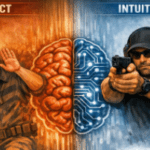
When using a firearm for self-defense you don’t have the luxury of relying on instincts. Many gun owners use the terms instinct and intuition interchangeably. They are two very different engines driving your performance. Understanding the distinction can be the difference between a controlled, legal response and a tragic mistake.
Instinct: The Primal Hardwiring
Instincts are the “factory settings” of the human brain. They are unlearned, biological impulses designed for survival. Examples include, the Startle Response. If a loud bang goes off behind you, your shoulders hunch, your head ducks, and your hands fly up. That’s instinct. The Flinch: Anticipating the “bang” of a handgun and pushing the muzzle down is an instinctive reaction to a controlled explosion happening inches from your face. The Problem: Instincts are often counter-productive to accurate shooting. Evolution didn’t design us to maintain a perfect sight picture while a predator charges; it designed us for fight or flight, but nowhere in our DNA is it programmed on how to fight with a firearm.
Intuition: The Expert’s Shortcut
Intuition is a subconscious pattern recognition. It is the result of thousands of hours of experience condensed into a split-second feeling. An intuitive well trained gun owner “senses” trouble because their training has conditioned their brain to create a catalog of subtle cues—a hand reaching into a waistband, a specific “thousand-yard stare,” or a shifty weight transfer. In a high-stress encounter when it is “go time” a well-trained intuitive shooter doesn’t think about the grip, the presentation, the sights or the trigger press. The brain recognizes the target and the body “knows” when the shot is aligned. Intuition allows for speed without chaos. When you don’t have to think about how to get your gun into the fight, you have the bandwidth to focus on other things like the location of your family, your backstop or innocent bystanders in the area. It filters out the noise and focuses only on the variables that matter.
You can’t delete your instincts, but you can “reprogram” your response to them. This is why dry fire and stress inoculation are vital. By repeatedly performing a perfect draw stroke in a calm environment, you build a “new normal” that competes with the startle response. Training teaches you the technique, and practice replaces the counter productive instincts with intuition. As you progress, vary your training by adding movement, different scenarios and decision making. Force-on-Force using simunitions or airsoft against a thinking human opponent teaches your brain to recognize human behavior and analyze and respond to changing situations. While you can become more intuitive by trial and error, good training classes help you skip the resource intensive DIY process, and helps you get become an intuitive, well-trained shooter much quicker.
