
Visible vs. Low Profile Church Security: A Layered Best Practice Approach
By Jeff Williamson and Joey Howell
A question that comes up in nearly every church safety discussion is whether security team members should be clearly visible or operate in a low profile, undercover manner. People sometimes treat these as opposing strategies, as if a church needs to choose one or the other. In reality, the strongest and most resilient security programs rely on a layered approach that blends both. The goal is simple: deter problematic behavior before it starts, while still being able to detect and respond to threats when deterrence alone isn’t enough.
Visible security plays a major role in prevention. When team members are posted at main entrances, monitoring exterior doors, or stationed in high traffic interior areas, their presence alone discourages many impulsive or opportunistic individuals. Attendees often feel reassured knowing there is a clear, organized system in place. And should law enforcement ever need to respond, easily identifiable team members help officers quickly determine who is part of the solution rather than part of the problem.
But an entirely visible team comes with limitations. Someone intending harm can easily observe, avoid, or even target them. Individuals who might otherwise display pre incident indicators often suppress those behaviors when they know they are being watched. And if the team presents too much of a “police-like” posture, the environment can feel less welcoming, especially in a worship setting. Visibility must be intentional—calm, professional, and reassuring rather than intimidating.
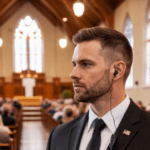
This is where low profile or undercover security becomes essential. These team members blend naturally into the congregation. Because they do not stand out, they are able to observe people as they truly behave. They can spot early warning signs that visible staff might never see. They can “bird-dog” or quietly follow a person of concern without escalating the situation. And if an incident occurs, an attacker may be caught off guard when a trained responder is suddenly much closer than expected.
Yet a completely undercover approach also has its drawbacks. Without visible deterrence, there is nothing to discourage a motivated individual. Someone who is already planning harm may feel more confident if they believe no security elements are present. Undercover team members also carry a greater risk during a law enforcement response, since officers may not immediately recognize them. Even well meaning congregants might assume the church has no security at all.
For all of these reasons, the most effective model is a layered, hybrid system. Churches benefit when visible team members serve as the first line of deterrence, presenting a calm, welcoming presence that signals organization and preparedness. At the same time, low profile personnel circulate through the congregation, hallways, and gathering spaces, paying attention to behaviors that don’t match the environment and responding quickly if something begins to unfold.
Before implementing any hybrid plan, it is vital to coordinate with local law enforcement. Expectations need to be aligned well in advance, and the security team should establish clear identification methods—vests, lanyards, armbands, or similar items—that can be immediately displayed if an incident occurs. Armed team members must be trained in how to holster safely, show empty hands, and follow commands when police enter the scene. These practices help mitigate one of the greatest risks associated with low visibility team members.
In the end, the formula is straightforward: visible security deters, undercover security detects, and a prepared team using both enhances response. A church relying only on visible presence becomes predictable. One that relies solely on undercover personnel sacrifices deterrence. A balanced, layered approach provides both safety and peace of mind while maintaining the warm, inviting environment a church is meant to offer.
